This is pretty much our class in a nutshell.
Wednesday, February 26, 2014
Another Class, Another Blog
Today we reviewed a lot of material with help from Mr. Schick assistant teacher, Devin. We focused a lot on the differences between Sparta and Athens. They were both very war based, but for Sparta it was their main purpose. The Spartans focused on having extremely powerful soldiers while the Athenians focused more on education and advancements. The Athenians were also a lot more forgiving and accepting than the Spartans. In Sparta, their rules of their society were pretty much set in stone, while in Athens they were very accepting of new and foreign things.

Greek Geography
Today we talked about the geography of the Greek civilizations and how they used it to an advantage against their other enemy. We also talked about Homer and the Odyssey. Mr. Schick explained how read the 12000 line poem to his young daughter which was pretty funny. It is cool to see how civilizations advanced as they go on, and how they learn from the previous ones.
Monday, February 24, 2014
The Greek City States
pg. 51-59
Key Notes
Key Notes
- Rose up when there was no one to stop them
- Sparta and Athens were the largest and the size of a US state
- Acropolis- a combination of fortress and temple precinct
- Each community revolved around a certain God
- Greek city states began to form when the Assyrians gained power
- Were not very wealthy to begin with
- Hostilities were equipped with bronze armor, round shields, and iron swords
- Phalanxes- known as "rollers"
- Theseus- King of Athens, offspring of Poseidon and Aethra
- Monarchy- government by royalty
- Began to use oligarchy
- Oligarchy- Authority was to a small group of people, while the majority did not have much say in the government
- In other places the majority had power instead
- Each city states government was diverse
- Triremes- massive fighting vessels that would ram and board other ships
- required a lot of people so it was mandatory for volunteers
- Began to use democracy
- we still use it today
- tyranny- one supreme ruler, having a dictator
- Spartans were descendant of the Greeks
- ruled over the majority of helots
- With the uprising between the Spartans and the Helots, the Spartans needed to accept a government that gave them supreme power
- New government also consisted of Elders, 2 kings, and 5 officials called ephors
- ephors were elected annually
- Spartan Government = Oligarchy
- Boys began to learn how to become powerful and they could marry at age 20
- Girls began to learn how to take care of children and to care for their husband
- did not have much freedom
- Sparta was very successful
- Sparta had a great army
- Athens thought that the Spartan life was not one worth living
- Athens was the complete opposite of Sparta in every aspect
- besides the fact that they were seeking conquest
- Used all sorts of different government types
- Athens rapidly grew and became a thriving civilization
- Had an extremely large population which later on led to conflict
- usually between aristocrats
- Athens had a navy
- Boys > Girls
- Developed into democracy after many different government types
- Persian wars began and they conquered the border of India to the Nile
- Darius I was the Persian king
- Athens declared victory over Persia
- All of the power rested on the assembly
- Officials had a big responsibility and had to help keep things in order
- Ten generals
- ostracism- to exile for ten years
- was decided by community votes
- Aliens- people who were unknown or had come from somewhere else
- Slaves were still very popular in Athens
Friday, February 21, 2014
Student Substitute
Today we had auditions for our student substitute on Monday. As each student went up to the board to read their notes, I soon realized. Each time they went up to the stand we heard the same things OVER AND OVER AGAIN. As they ended their presentation we had to clap for their amazing teaching skills.

I cant wait until Monday. In other news USA lost. Canadians these days....
Wednesday, February 19, 2014
Quiz Dissapointments
Today in class we got our quizzes back. To be honest I am really disappointed in my grade. I feel like I could have, and should have done a lot better. I went into it confident but I soon realized that I studied some of the wrong things. There was just a lot of time where I narrowed it down to two answers and just picked the wrong one. The quiz itself was not hard though. So much SHAME.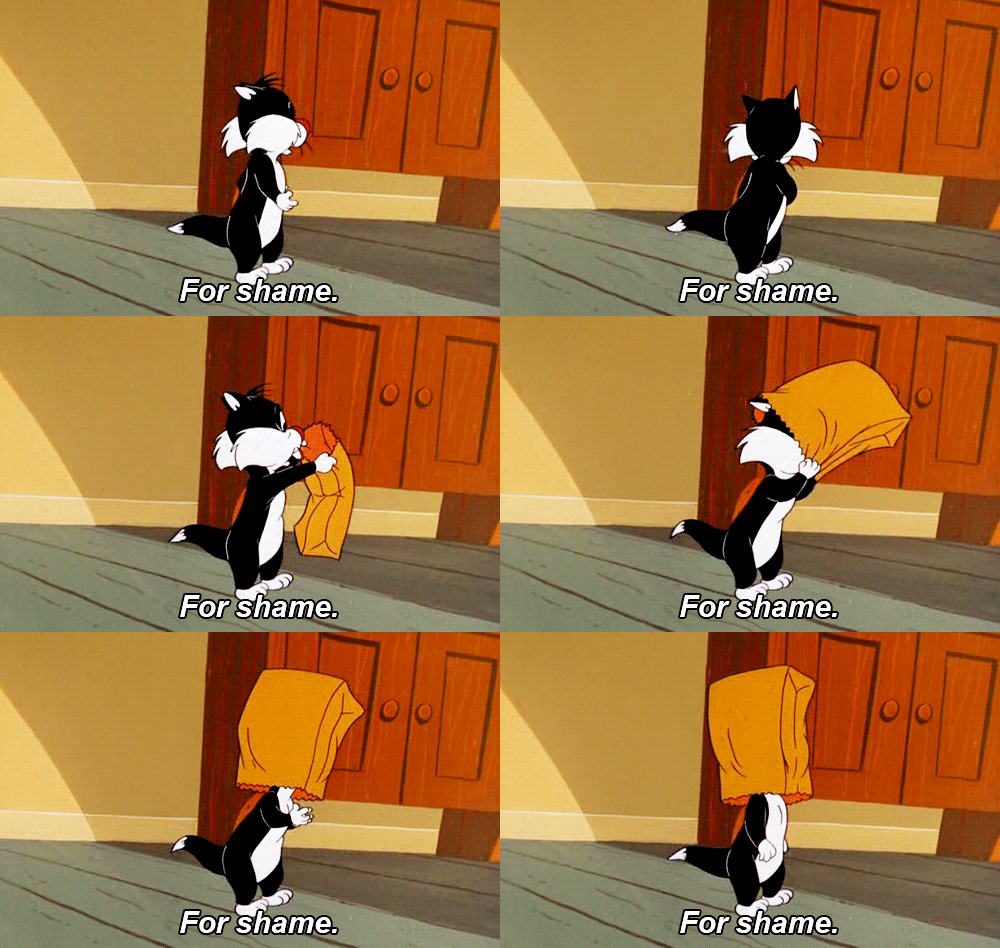
Tuesday, February 18, 2014
Build-a-Pyramid

Today in class we played an interactive game where we were in charge of designing and building a pyramid in a short amount of time. I was the 3rd person to finish after dozens and dozens of tries. The entire room was chaos while people were racing to get the better grades before they were gone. Everyone was about ready to throw their laptop. Not the best day of class.


Monday, February 17, 2014
The European Babrariens
As we continue in our journey of western civilization, we are about to enter the world of the Greeks. They were the first European civilization and developed differently then the ancient Egyptians.
There were some key concepts in this section.
- 2,200 to 400 B.C. - Lifespan
- based their civilization on farming and raiding
- were a very brutal society
- people began to migrate for self government
- invented the plow
- Stonehenge was believed to be built by farm and townspeople
- Greeks were polytheistic, similar to the Egyptians
- Fought for other's goods
- Persian Wars
- Greeks also believed in an afterlife
- Created many well known land marks (Pantheon, Erechtheum, Stonehenge)
Short Answers
The Ancient Egyptians may be known for their pyramids and mummies but they are also greatly known for their innovations and inventions. They had created a clear form of written writing, sailboats, calendars, and much more. Most of the things they invented is still used even today!
The Egyptian civilization were full of innovators, who came up with all sorts of new inventions and concepts. When you think about ancient writings, many people will think of the Egyptian hieroglyphs. Hieroglyphics was a form of writing a little different than it is today. Instead of having separate and individual words and symbols, they were drawings representing events and showing a story. These hieroglyphs were legible enough for us to find out later about the Egyptian history. Although it was not the first kind of writing, it was certainly an idea of its own and a great improvement. One major advantage the Egyptians had with these writings is that they could easily write them down and store them with the invention of Papyrus. Papyrus was the ancient Egyptian form of paper. It was made from using the pulp of the papyrus plant to create a sheet that they could later roll up into a scroll for easy storage. It was not quite as flimsy as today paper, but it was a huge improvement from writing on stone and clay. Another great invention from the Egyptians was the calendar. Before the Egyptians, there was no real sense of time. Time was a man made idea that is known by everyone today. Before the calendar, people just assumed that everyday was a different and new day, no one really knew about the earths climate and rotation cycle. The Egyptians picked up that at different times of the year, the world around them was different and they eventually created a 365 day cycle that would repeat every year.
The Egyptian civilization had so many great inventions, so great that we still use them today. The Egyptians really sought out out problem solving and invented new things to make their daily life easier and allow their society to advance. Their civilization truly thrived on this and it kept it alive.
The ancient Egyptian Pyramids might be the most well known accomplishment of their civilization. These giant pyramids are still standing today and are one of the most popular tourist attractants in the world. The pyramids are not all for show though, they have some key features that make them so unique.
The pyramids in Egypt are truly a work of art. They were used to store the diseased bodies of former Pharaohs to preserve, protect, and prepare for the afterlife. The Pharaohs were mummified because they believed that they would need their body in the after life. They took all of the organs out except the heart and placed them in jars that were stored inside the pyramid with them. There were all sorts of prized possessions with the dead Pharaohs in these pyramids. They believed that if they were with them in the pyramid, then they could still have them in their new life. Another key feature to the pyramids were their very distinct design. They were extremely tall and were originally covered in a beautiful marble coating. These large scale of the pyramids allowed multiple bodies and their possessions inside the pyramids. Along with that, they made all sorts of fake passageways and rooms to confuse any raider trying to loot the pyramid.
These pyramids left a reminder for future generations of the success of the great Egyptian civilization. The workers who slaved away at building these pyramids enjoyed what they were doing. They were proud to be able to work on these great monuments. The ancient Egyptian pyramids were both functional and a landmark as well as being one of the most iconic in the world.
Thursday, February 13, 2014
Essays
Essay A
Ancient Egyptians social hierarchy made them stand out from other civilizations. At the top as a half god half human stood the Pharaoh, and going to the bottom was the lower class consisting of farmers and slaves. This system gave the upper class more privileges than the lower class and they lived a richer life.
The Pharaoh was the ruler of two lands and lived as a god among his people. He controlled everything around them and was responsible for the world around him and his people, no matter if it was good or bad. In fact, Pharaohs would even be replaced when going through bad events such as droughts. Below the Pharaoh, there was the upper class men. These people were known as the "white kilt class". They consisted of government officials, priests, physicians, and engineers. Below them was the middle class and then the lower class. The middle class consisted of mainly merchants, artisans, and some farmers. At the very bottom lied the slaves who would work for the higher classes. The higher up on the pyramid you go, the more successful you are and could live a better life.
This life style seemed to work out well for the ancient Egyptians. They had a government system and everyone knew there role is society. This hierarchy allowed the Egyptians to be able to make civil decisions because they had a supreme ruler, the Pharaoh. This newly developed society pyramid has developed over thousands of years and into how it is today.
Ancient Egyptians social hierarchy made them stand out from other civilizations. At the top as a half god half human stood the Pharaoh, and going to the bottom was the lower class consisting of farmers and slaves. This system gave the upper class more privileges than the lower class and they lived a richer life.
The Pharaoh was the ruler of two lands and lived as a god among his people. He controlled everything around them and was responsible for the world around him and his people, no matter if it was good or bad. In fact, Pharaohs would even be replaced when going through bad events such as droughts. Below the Pharaoh, there was the upper class men. These people were known as the "white kilt class". They consisted of government officials, priests, physicians, and engineers. Below them was the middle class and then the lower class. The middle class consisted of mainly merchants, artisans, and some farmers. At the very bottom lied the slaves who would work for the higher classes. The higher up on the pyramid you go, the more successful you are and could live a better life.
This life style seemed to work out well for the ancient Egyptians. They had a government system and everyone knew there role is society. This hierarchy allowed the Egyptians to be able to make civil decisions because they had a supreme ruler, the Pharaoh. This newly developed society pyramid has developed over thousands of years and into how it is today.
Tuesday, February 11, 2014
Sub Studying
Today Mr. Schick was not here, and instead we had a sub. We were assigned to study and look through our notes to prepare for our quiz. I feel pretty confident on the material and feel that the quiz should not be too hard. It focus' on Pre History, Mesopotamia, and Ancient Egypt.
In other news. THERE WILL BE MORE SNOW THIS WEEK

In other news. THERE WILL BE MORE SNOW THIS WEEK
Mummies!
Today we had some interesting conversations about what it would be like being buried in the ground, and how mummies were made. We reviewed the Egypt section and I feel like I have a solid understanding on it. I believe we have a quiz Wednesday and I feel prepared. I found this section really interesting and hopefully the next sections will be as well.
Monday, February 3, 2014
Into Egypt
Today in class I did not have my laptop so I was unable to take down any notes on the section, but I got to read over the chapter and can remember some things. I also was not here on Friday. I am unsure of these new "note taking techniques" that was taught on Friday. Last Friday I was out sick with some sort of acid reflux issue. It carried out through most of the weekend and was not very fun. Anyways back to the section. There was a lot of info on the Pharaohs. The Pharaohs were the rulers of their people and they were the at the top of the hierarchy. They would have multiple wives, and children, allowing the royal blood to move on through generations. The Egyptians were also some of the first people to invent a form of writing. They used hieroglyphics which were drawings that represented a story. This allowed them to record what had happened and let future generations know about their past. The Egyptians really seem like innovators and I am interested to learn more about them.
Subscribe to:
Comments (Atom)